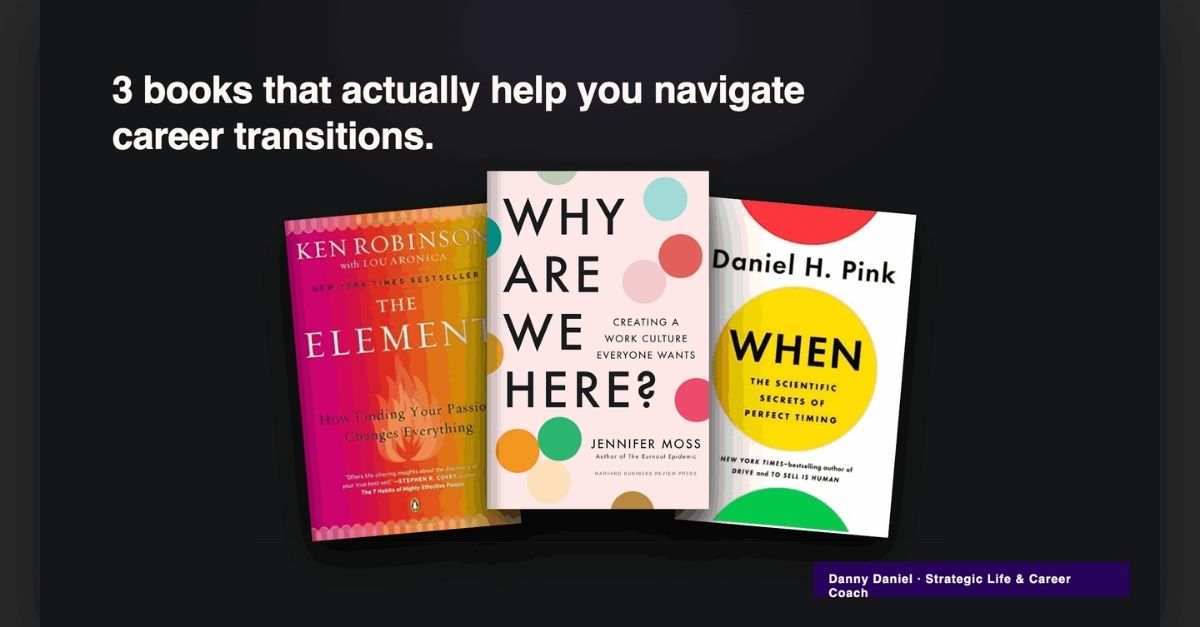
On why most career books don't work and what makes these three different.
I've read over fifty books on career transitions over the years. Most aren't useful, and it's not because the ideas are wrong. It's because they tell you what to do without looking at two things that change everything: when you're making that decision and from what internal state you're making it. And that part, which is what most determines whether the decision is going to hold, almost nobody addresses.
The career coaching industry was built on the idea that if you have the right framework, the right steps and enough motivation, you can change your life. It's a tempting idea because it's simple. But it isn't true. Because a good framework executed at the wrong moment doesn't take you anywhere. And a technically correct decision made from exhaustion or anxiety almost never holds over time.
That's why when someone asks me what books I recommend when they're in the middle of a transition, I have a very short list. Three books. Not thirty. And each one answers a different question that most professionals don't ask themselves seriously enough.
Because it asks a question most professionals have never seriously considered: not what you should be doing, but what comes naturally when nobody is evaluating you. That distinction sounds minor. It isn't. It changes everything.
The vast majority of people who work with me arrived at their current career for perfectly valid reasons at the time, but reasons that had very little to do with what actually comes naturally to them. They chose what was practical, what was profitable, what their parents approved of, what the market was asking for when they were twenty. And that built a functional career without real connection to who they are.
Robinson argues that your element is the intersection between what you do well and what you love doing. Not what you tolerate because it pays well. Not what looks prestigious on LinkedIn. What you do without anyone asking you to and lose track of time while doing it. That kind of information rarely shows up on a vocational test and almost never in a job interview. But it's there, in your history, if you know where to look.
Because she says something most people aren't ready to hear: burnout is almost never your fault. It's a misalignment between who you are and the context you're in. If you think the problem is you, you look for the solution only inward. When the solution also requires changing something outside.
This book is especially important because it dismantles a narrative that has done a lot of damage: the idea that if you're exhausted it's because you don't have enough discipline, you don't meditate enough, you don't manage your time well or you don't handle stress well. Moss demonstrates with solid research that burnout isn't an individual problem but a systemic one, and that many times the best decisions a professional can make aren't about personal productivity but about environment.
For someone in transition this is fundamental because it pulls you out of the trap of thinking you have to fix yourself before making big decisions. Sometimes big decisions are exactly what allows you to fix what doesn't get fixed with more self-help.
Because he documents something most people ignore entirely: not all moments are equal for making decisions. There are moments where your judgment is sharper and there are moments where your brain simply isn't in a condition to evaluate clearly. Most professionals I work with made their most important career decisions during one of those low-clarity moments. Without realizing it.
Pink gathers decades of research on timing applied to decisions, productivity and strategic decision-making. And what he shows is that knowing when to make a decision matters as much or more than what decision to make. A correct decision made at the wrong moment becomes hard to sustain. An ambitious decision made at the right moment, with the right clarity and energy, becomes natural.
This is the book that most changes the way my clients relate to their own decisions, because it gives them something no one had given them before: a framework to understand that they aren't failing at making decisions, they're making decisions at the wrong moments without knowing it.
None of the three tells you what to decide. What they do is help you understand where you are and from when you're deciding. Which is exactly where most professionals get stuck, even though they think the problem is something else.
If you're in the middle of a career or life transition, my honest suggestion is that before reading the next book on productivity, professional strategy or personal branding, you read at least one of these three. Because without understanding your element, without understanding your context and without understanding your moment, any strategy you apply is going to be built on a base you don't know. And the strategies that work are the ones built on bases we do understand.
With purpose,
Danny Daniel.




.jpg)